
The Greater Boston-based yoga instructor explains how trance breathing can induce a therapeutic psychedelic-like experience
David Magone is a Greater Boston-based yoga and meditation teacher and program director at Down Under School of Yoga. As a consultant for the Harvard T.H. Chan School of Public Health, he develops breathwork protocols for PTSD and psychedelic studies. His personal experience overcoming PTSD through meditation,yoga, and self-guided psychedelics led him to a deeper exploration of therapeutic modalities like trance breathing.
Dynamic Volitional Respiratory Modulation (DVRM), or trance breathing, is a non-pharmacological method that induces altered states for healing and personal growth through breathing exercises. Magone collaborates with scientists at Harvard, MIT, and MGH to study its effects and is offering a workshop this weekend (in the meantime, you can learn more about DVRM here). We asked him about all of the above and more.
JS: How did you get into this work?
DM: I had PTSD from an accident when I was 12. One of the major contributors to my recovery was a self-guided psychedelic experience. During that process, I discovered that what makes a psychedelic experience therapeutic is the introduction of a blindfold. Generally, when people are having a psychedelic trip, they’ll microdose or take a full dose of mushrooms and interact with the world. They’ll hang out with their friends; they’ll go to the forest or look at the sky.
Consequently, the trip sort of coalesces around everything external that they’re seeing. When you have a blindfold on and you’re not interacting with the world, the brain zooms in on things that need resolution, things that haven’t been addressed, or that are salient and relevant to that individual.
What exactly is trance breathing, and how did you discover it?
After my psychedelic experience, I noticed similarities with Tibetan meditation and breathwork practices. This led me to research if others had achieved psychedelic states through breathing. Various communities, like Sufi mystics and Siberian shamans, have used specific breathing techniques to induce altered states. Stan Grof, the creator of Holotropic Breathwork, has also been teaching this method for decades.
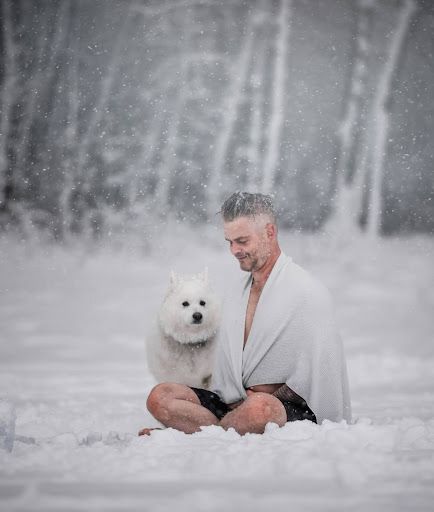
I just decided … I’m gonna experiment with this, too. So, I threw on a blindfold, not really believing that it would work. And 20 minutes later, I imagined turning into my German Shepherd running through the snow and can still feel the fur on my back to this day.
Trance breathing is a way to access altered states for healing without drugs. People have reported drops in anxiety and depression, and it’s especially useful for trauma, ongoing therapeutic work, or for those who can’t use psychedelics. We’re building protocols for mental health professionals and looking at applications for PTSD, depression, and caregiver stress.
How did you get involved with Harvard and scientific research?
I met two students through yoga who have supported and helped shape my work. One was Karestan Koenen, a Harvard professor and PTSD expert, who helped me make somatic modalities more accessible. The other was Susan Whitfield-Gabrieli, a Northeastern [University-based] neuroscientist. After I shared how breathwork induced altered states, I asked Susan if she would like to study the effects with me. Despite the complexity of brain imaging, she agreed, and with Karestan’s involvement we completed a study with Harvard, MIT, and MGH. Now, after years of teaching, I collaborate with Boston’s scientific community as a consultant for Harvard T.H. Chan, writing breath protocols for PTSD and psychedelic-related studies. (Read about the study here.)
How does trance breathing compare to psychedelics?
If you want to jump off the magic carpet, you can do that anytime you want to. With mushrooms, you’re on the ride whether you like it or not. Breathwork is a non-pharmacological alternative, and it’s great for people who can’t or don’t want to use substances, for example certain professions, like first responders or those worried about stigma or legality. It’s inexpensive and accessible.
What does science say about trance breathing?
We did the first-ever fMRI studies to see what happens in the brain during trance breathing. This was tricky because fast breathing creates movement, which usually messes up the scans. But with help from Ken Kwong, who’s a pioneer in fMRI, and by adapting the breathing protocols, we got clear readings for the first time. The results showed unique brain activity during these states. We’re now working on EEG studies and collaborating with other universities to expand the research.
What happens in a trance breathing workshop, like the one you are hosting on September 14th at Down Under Yoga in Cambridge?
You’ll come into a room with about 60 people, get a little intro, then lie down with a blindfold and start breathing together. Once the state sets in, everyone’s experience is different—some people revisit memories, some have visions, some just feel amazing. Whatever comes up is extremely relevant to the individual, and it seems to be what they need at that moment.
Who shouldn’t do trance breathing?
People with unregulated high blood pressure, epilepsy, certain psychological conditions, or who are pregnant should avoid it.
What advice do you have for newcomers?
You can join a trance breathing workshop for the full experience or try shorter breathwork sessions at the end of my regular yoga classes to get a taste. For newcomers, come in with curiosity and no expectations. It’s always hard at first, and then something clicks in your body, and it gets easier. Adjust your breathing pace as needed and just keep going until your body takes over.
Check out David’s workshop at Down Under School of Yoga in Cambridge on Sunday, Sept. 14 from 1:30 to 4pm. Sign up here for the Porter Square event or livestream.