
“If you look at standardized agriculture, everything is done through a cooperative or teamwork. … That’s what we’re going to be focusing on.”
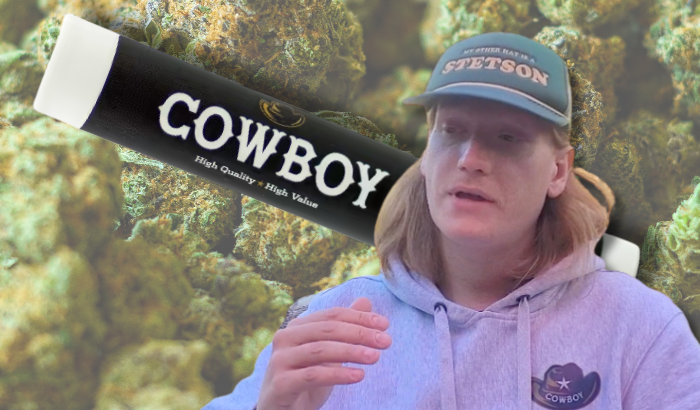
Avery Leveston is a staple in Mass cannabis. A familiar face around the industry with an uncommon Stetson crown, he has worked for companies large and small alike since the dawn of recreational dispensaries, and now he’s building out his own brand, Cowboy Kush, with a deliberate and somewhat unique mission.
We first spoke with Leveston last spring, soon after he launched. Now that he’s been at it for half a year, we checked back in and things appear to be on track as planned, with Cowboy partnering “with local cultivators to ensure fair compensation while delivering high-quality, full-flower, high-terpene products at accessible prices.” “We handle the entire supply chain for farmers,” Leveston pledges, “so they never have to worry about anything other than great quality cannabis.”
In its first six months of collaborating with premium outfits including Lazy River, Cowboy sold nearly half-a-million single pre-rolls. They’re currently in 60 stores. We followed up with Leveston for an update on his burgeoning enterprise, as well as for the story of his agricultural background—including the origin of his signature 10-gallon hat—which led him to cultivate his own modern spin on a cannabis co-op, a model he says “allows me to build the relationships I need for Cowboy Kush to succeed.”
There are varying kinds of cannabis co-ops, but explain the way that you’ve developed yours?
Typical cooperatives are an equal equity stake. Each farmer, each small business, will have an equal equity portion of the company. For us, I say cooperative-style because we work with every different piece of the supply chain. Technically, I own 100% of the company, but the core of the business is really partnerships, cooperation, and teamwork.
Give us an example. How would it work? If I’m a small cultivator, how does that work?
I’ll approach you. I first figure out what your cost to produce is. That’s the first question we always ask our cultivators: to determine if they fit in our price range. If they do, we then ask, How much material will you have access to per month? When we work to take on some of that, we’ll also find ways to potentially reduce their cost of goods sold and bring down their overhead so their margins are higher. Once we take that product, we handle the rest of the supply chain. We keep it really easy for our farmers.
You handle it and you’re working with one centralized location, unlike a similar model other people are doing. You have a home base and storage. It doesn’t mean that much to the consumer, but what are you able to do with that?
We’re able to control a lot of aspects of the supply chain. We’re starting to build out a logistics regimen. We send product from the farms to the co-packers. Every two weeks, the shipments come back to the main storage vault. I utilize Apex Trading, an online software platform that presents our menu in an efficient way. Products come back to the storage vault, I upload them to Apex, work to deliver those products, and then I go out and service all those retail partners. That’s the last step of the supply chain.
Now, let’s talk about the fun part. I am currently smoking a truly outstanding Pie Cake. Where is that from? And give us a couple of your strains, where they’re from, and what’s special about that relationship.
Each cultivator is very different in their own aspects, whether they grow indoor, greenhouse, or outdoor. That specific Pie Cake is going to be from Lazy River. They’re an indoor cultivator located in Dracut, very focused on the terpene profiles. That’s one of the core focuses at Cowboy Kush. We’re not like every other company that focuses on the THC; we really focus on the quality of the buds. The Pie Cake is a perfect example: testing in the teens, but our terpene levels are an unbelievable 2.5 to 3%. We provide that pre-roll to consumers at a great price.
Do the cultivators say, We have this and that, or are you going through their menu and saying, We have a few already, we’re looking for some kush? How does that work?
I’ve been in the space for eight years, really focused on building a network and relationships to ultimately launch my own company. These are people that I’ve built relationships with for years. I’m frequently touching base with them on a weekly or bi-weekly basis to see what their bulk availability is like. The unique aspect of cannabis is every plant is grown differently; you might yield more one month, you might yield less. The amount of excess these farmers have is going to vary. My job is to continuously maintain that relationship and almost be the first right of refusal so they call me instead of someone else.
We haven’t talked about price point, but you’re striving to have a reasonable price point, and they’re selling as a result. How does that work? Is it because you’re floating between places you’re able to do that?
We’ve built a business where we procure product at a certain per-pound price range. That price range is $400 to $600 a pound. We procure product from various farms throughout the state within that range, which brings us to an average per-pound price that allows us to offer an everyday low price on the wholesale side.
What are most of these pre-rolls mostly selling for?
Most of these full gram pre-rolls are selling for around $5, or $6 with tax. Full grams are always full flower—that’s our big focus. We’re actually working with two companies right now. One is the RollPros. We’re working to implement a certification to really show that the pre-roll is full-flower-focused, not a trim or shake option. The second, which will be advantageous, is we’re a very sustainable company. We’re working with rePurpose Global. We’re going to be the second cannabis operator in Massachusetts to work with them. They’ve given us a credit for every thousand units of packaging we purchase, which goes back to removing plastic from oceans around the world. That’s for our pre-roll tubes. Coast Cannabis is the first company in the state to offer that.
Strains—what flies off the shelf? What’s really clicked so far? And does the Cowboy Kush branding impact the strains you’re looking for?
I think the branding is a little separate; I wouldn’t say it’s a big focus of what we procure. Like I mentioned, that quality standard is the first criteria that has to be met. We’re looking at any excess from all the cultivators, but what we’ve found is those buds that typically have the higher terpene levels are the ones we seek.
Furthermore, strain names like Blue Dream are going to sell a little better. We do have an eye on the market. For example, one of our amazing facilities, Greenfield Greenery, grows a Humboldt cut of Blue Dream that they get out of Cali and grow on their farm. We’re going to be working with them to lock in what will potentially be the first in Massachusetts cannabis futures contract, where we contract with them over 12 months. We’ll take in Blue Dream on a monthly basis, whether it’s 30, 40, or 50 pounds of excess. We’re going to write them a check upfront and then pay them the rest over time.
What else do you have and from who?
We have quite a few different options. We got the Garlic Butter and Blue Dream from our outdoor side. We were very specific with the outdoor flower, only working with two outdoor cultivators because we found the quality was only met with those two facilities at this time. The Blue Dream and the Garlic Butter come from Greenfield Greenery. I will say the outdoors are mostly our favorites, and I believe it’s due to the terpene complexity that sunlight provides, giving a different experience.
Also, the cannabinoid diversity—we’ve really noticed a lot of minor cannabinoids available in these strains, which is unique. Then we have the Pie Cake from Lazy River. And then we have an OGKB from Renew Cannabis. They are an indoor facility in Milford. The individual who runs that was actually my first boss in cannabis eight years ago, Matthew Radebach. My first gig was at Alternative Compassion Services in Bridgewater. I was licensed by the Department of Public Health before the CCC was even an organization.
I guess we should have started with it, but tell us, where does the name Cowboy Kush come from?
I was down in Kentucky for school at the University of Kentucky, and I really learned about the agricultural side of things there. I went to the college of agriculture. That’s where I started wearing Stetsons. I loved wearing a cowboy hat. The company idea actually came from a business card. I made a business card that was just the shape of a cowboy hat, and multiple clients kept telling me I should brand this. So, I merged some of the business tactics I saw on the agricultural side down at the University of Kentucky with the problems in the cannabis market, and then merged it with the business card. That’s how Cowboy Kush came to fruition.
With that background, I can’t let you leave without asking about hemp. Kentucky is the nerve center of all this. Do you see promise in hemp? Is that something you would be interested in with this brand?
I was actually very interested in launching this company down in Kentucky. The Cowboy name definitely would have performed better culturally there. They legalized medical cannabis consumption earlier last year. I went through a lot of the regulatory language. My stepmother is actually on the Medical Cannabis Advisory Board, so she administers the licenses. But there were a lot of problems in that market. I determined it wasn’t the right time to enter. I came up to Massachusetts to build the business, and once Kentucky gets its act together, maybe.
How about on the hemp side? Does it interest you at all?
I would definitely be interested in the hemp side. I talked to my brother yesterday about potentially looking to launch a vape line where we could contract with hemp companies and distill it. But that’s a ways out right now. We really want to stay focused on just the flower side and building a family here in Massachusetts.
One of the core reasons we started this company is there’s so much individualism in this market. In reality, if you look at standardized agriculture, everything is done through a cooperative or teamwork. Farmers, logistics companies, and manufacturing companies all work as a team to get products to the grocery store. Why aren’t we doing this in cannabis? That’s what we’re going to be focusing on for a minute.