Michou Olivera’s unique psychedelic lifeline out of Massachusetts
Michou Olivera had a vision.
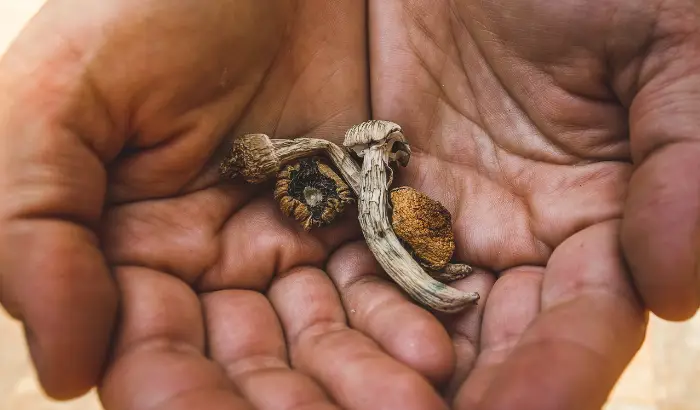
While homeless and tripping on three-and-a-half grams of Golden Teacher mushrooms, she saw her future: hundreds of people coming to her for mushrooms and help with their psychological, physical, and spiritual needs.
The only problem? She needed the mushrooms. And the knowledge. So she got to work.
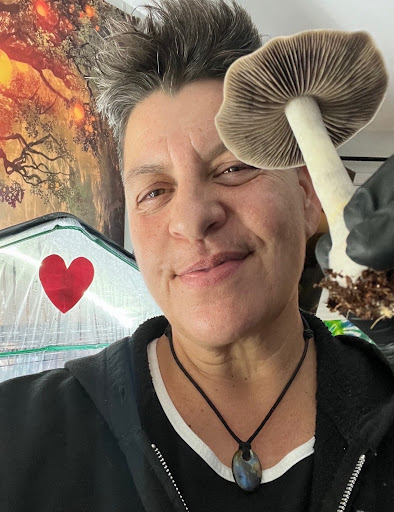
Eight years later, Olivera is now a “psychedelic guide, educator, and mycologist” in Easthampton who gets clients acquainted with psychedelics. Her service is unique but comparable to that of licensed centers in states like Colorado and Oregon, as she assists people before, during, and after mushroom use. She operates in a legal gray area, since the Easthampton City Council passed a resolution decriminalizing the possession and use of psychedelic plants in 2021.
In her work, Olivera helps the curious pick the right varieties, gauges proper dosages, and prepares people for their psychedelic experience. A big part of the journey is a process known as “integration,” during which clients glean insights from their trips.
Olivera has no formal training as a psychedelic guide, and her journey to this point has not been smooth. Her education comes from firsthand encounters and research, both in real life and through a wide breadth of books and journal articles available.
“Most of my life was really difficult,” she said. “I was really at the helm of driving my ship of misery without knowing.”
Dark side of Half Moon Bay
Now 56, Olivera was born in Half Moon Bay, on the northern California coast. Always “curious about altered states,” she recalled having her first drink at 13 and experimenting with drugs in her youth. She was also growing up as a masculine woman in a time when alternative gender expression was not widely accepted. Whether LSD or cannabis, various substances offered an escape from her challenging home and personal life.
In 2018, around the height of Olivera’s alcohol use, she took mushrooms for the first time in decades. After this, she would macrodose once a month for two years, taking a large amount of psychedelic mushrooms that would create more intense sensory and perceptual experiences. For Olivera, this time was turbulent in many ways, as she was facing homelessness and actively battling addiction.
After a series of particularly powerful psychedelic trips, she finally quit drinking. Visions of her future, in which she would help people through spiritual journeys, spurred what she described as a profound need to learn about mushrooms, since people would eventually come to her for guidance.
While homeless in her late 40s, Olivera said that she would wander into the woods, find a spot near the water, and cry. Her psychedelic trials challenged her perspective, and she felt as though she had uncovered a new lens—one more attuned to the world around her than she had been in several years.
After her self-described ego death during one such nature trip, Olivera began researching in 2019. “I wanted my mushrooms,” she said. “I need to understand them as a home, rather than just as these interchangeable things.”
Following a process of self-education, Olivera listed herself on a website aimed to connect patients with psychedelic facilitators. Just like in her vision, people started showing up. Today she grows more than two hundred varieties of mushrooms, and guides people through their pre-trip meetings, their journeys, and follow-up life integrations.
Different dose for different folks
In time, physicians and psychologists began to link their own patients with Olivera, typically when traditional therapy wasn’t working. These clients were “at the breaking edge,” she explained.
Some of her versatile insights come from growing her own mushrooms. Certain people need specific varieties; for example, if they’re taking SSRIs, or other medications. Regarding strains, some popular ’shrooms like Penis Envy can have mixed results, while less noted ones like Golden Teacher warrant more discovery.
“I get to know the person and give them the agency to make really smart choices for themselves,” Olivera said. “Like, Oh, they’ve got a history of anxiety, and this type of trauma, so they probably shouldn’t have Penis Envy.”
Olivera’s secret sauce is her ability to speak with someone, learn their history, and suggest the right mushroom, now mostly grown by her. One client who gave an interview for this article explained how she was on the verge of an extreme mental health crisis. Then she found someone who offered psilocybin treatment in the form of psychedelic mushrooms.
“I was really in a dark place with my illness and actually was planning to end my life,” she said. “I went into [the psychedelic trip] with a little bit of trepidation, but I was just at a point in my life where I was like, Fuck it, I’m either going to live, or I’m going to die.”
That client’s experiences with psychedelics reportedly altered her perspective. She increasingly connected with other people, and depression symptoms lessened. Eventually, her “background anxiety” disappeared.
Psychedelics over psychotropics
Other clients of Olivera also explained that her approach is grounded in practical experience and her embrace of mystical elements. Dr. Marie Sauro, a clinical psychologist, sought nontraditional treatment, wanting to understand it and perhaps eventually recommend it to her clients.
“Before I started working with [Olivera], I still had a considerable amount of just very diffuse, free-floating anxiety,” Sauro said. “It just blew open my world. I am 60-something years old and have never been out of the country, and just all of a sudden, started thinking to myself like, Is this what you want your world to be, your living room?”
Sauro said that she recently left the country for the first time, took her daughter to Europe, walked across Spain by herself, and plans to go to Peru in the near future. She no longer takes her psychotropic medication and now recommends psychedelic treatments to some clients.
“It could have saved a great many people,” Sauro said.
Despite mushrooms often being an effective tool, Olivera and others stressed that psilocybin’s not a magic bullet. Mushrooms aren’t going to “cure” your depression.
“The idea that pushing a breakthrough is the answer with mushrooms is really dangerous,” she said.
More than just a bargain
A point of pride for Olivera is her accessibility. Service centers in Oregon and Colorado have reportedly charged “as much as $2,500 out of pocket for an hourslong psilocybin trip,” in some cases. Microdosing can be less, but required training and licensing fees in those regulated states still lead to continued care costing thousands of dollars.
Olivera’s baseline prices are much lower, in the $500 range. And that is for a microdosing package with multiple sessions and integration meetings.
If price is a barrier for services, Olivera welcomes clients to pay on a sliding scale. But it’s more than just the cost that keeps people contacting her. One client underscored that the dual mystical and practical elements of her practice are what make her successful.
“It’s really powerful to work with someone very comfortable with that part of our humanity,” her client said. “Having been through her own growth process, just there’s an authenticity there in terms of the intent of the work overall.”
For Olivera, it’s central to her practice to let people know they have the tools within them to manage personal struggles.
“You’re the student of yourself,” she said. “When you’re working with mushrooms, you’re creating neuroplasticity, which is thinning the veil of your consciousness.
“What I’m offering is the ability for people to hold the mirror up for them and show them where this is coming from so they can see the truth of it.”