David Lakeman comes from Illinois cannabis program but started career with Massachusetts Municipal Association and CCC
How the search for a new executive director started
It has been more than 11 months since Massachusetts Cannabis Control Commission Executive Director Shawn Collins announced his resignation from the agency. Prior to that, his employment status had been unclear since July 2023, when then-CCC Chair Shannon O’Brien shocked industry stakeholders, fellow members, and Collins alike with an unwelcome impromptu human resources announcement during a public meeting.
Quite a bit has changed at the commission since that mass commotion, especially around job titles, duties, and positions. O’Brien was suspended and then eventually fired, while the remaining commissioners played musical chairs in the top appointed spot. Meanwhile, last October, members tapped Chief People Officer Debra Hilton-Creek to serve as acting ED, but then clashed eight months later as some members moved to redelegate her director duties to various department heads.
In January 2024, the CCC established an executive director search committee to “identify and engage search committee participants,” and to write a new job description. The regulations that established the agency left room for interpretation when it came to who does what around here and who is basically in charge, aggravations that demonstrably spurred confusion and disagreements between hired and appointed employees. Toward the end of her active tenure, O’Brien even questioned the intended statutory pecking order at a public meeting.
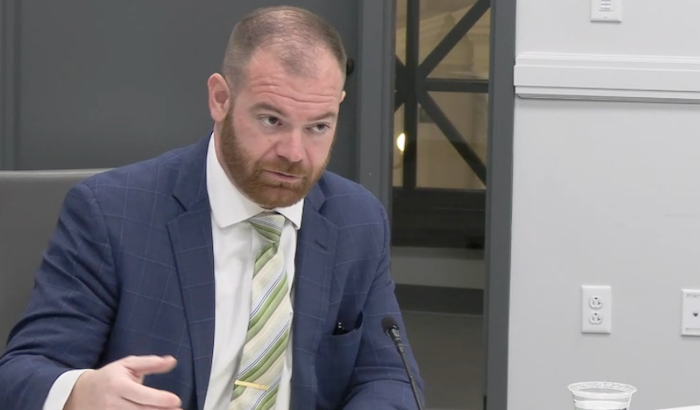
With a new job description, commissioners made clarifications. And Monday, roughly 10 months after officially starting their search, the three active members—Nurys Camargo, Kimberly Roy, and Bruce Stebbins, the chair—chose former CCC Director of Government Affairs David Lakeman to fill the position Collins left in December. The unanimous vote came after interviews with four finalist candidates.
The interview with David Lakeman
In his hour-and-a-half long interview, Lakeman spoke about his journey in cannabis regulation, from the early CCC in Massachusetts to the Illinois Department of Agriculture, where he has served as the cannabis division manager since 2022. His path to public drug policy started in 2015 when he took a job with the Massachusetts Municipal Association. Right away, he said, the MMA put medical cannabis issues and preparation for the advent of adult-use on his plate, leading to him visiting more than 200 cities and towns “to discuss the potential impacts of legalization.”
With those travels on his resume, Lakeman said that members of the Massachusetts “legislature reached out to me to work with the legislative working group which took a role in reshaping what the ballot question was.” From there, in 2018 he became the sixth staff member hired at the brand new CCC. He reminisced during his interview: “We made the joke often back in 2018 that we had the worst aspects of a company startup and also the worst aspects of a government agency. We had nothing, we were not set up. I still recall the office. We had a table that we brought in literally from a garage sale, we had a printer, and we had a small fridge that we bought off of Amazon. We all brought a few pens from the places we came from to get started.”
In 2020, Lakeman said he left the government affairs directorship in Mass to return to his native Illinois in order to be closer to family at the height of the pandemic. During his interview on Monday, Camargo asked flat-out why he wanted to come back to work at the commission, which is in a markedly “transitional phase.” The candidate explained that he’s been building agencies for the past several years, implying that he’s ready for the reins of something more established.
“When I went back to Illinois, the office staff for the program was two people, and there were five field inspectors,” Lakeman said. “As of the time that I’m sitting here, our count is 102. We’ve gone from 21 licenses to over 400. … My experience, the whole of my career for the past six years, has been building new. If I had a dime for every time I said we’re building the plane in mid-air, I could probably retire at this point. This is my experience. I have done this now twice.”
Lakeman on practices, procedures, and challenges
Before they formally picked him, commissioners seemed warm to Lakeman, who spoke in significant detail on several issues, but also hit a well-received pep talk stride conflating his past work in Mass with his future potential: “We have the opportunity to not just be a regulator but to genuinely be an inspiration. We have the ability to show what government in the 21st century could be if started fresh. We have the ability to be a regulatory agency that didn’t just regulate but actively undo harms that have been previously done to communities across our commonwealth for decades, and we had a chance to do that in a representative and thoughtful way. And I’m proud of that.”
Lakeman’s hopeful message connected. “There’s nothing we can’t fix,” he said at one point. “We can make a government unit that helps to restore faith in government by being responsive, by being efficient, by doing things differently—not just for our licensees, which is important, but also how we treat our staff, creating an environment of trust and innovation. We’re not ossified yet, we don’t have practices and procedures because that’s just the way we’ve always done them. We have the ability to truly do this differently and that’s how the commission was founded.”
He continued: “There have been challenges here. I don’t think that’s a surprise to anyone. Assuming they are solvable, if we just remove a little bit of the confusion [we can] get focused back on the core mission, because this team is amazing.”
Lakeman also spoke about his past coordination of the CCC’s Cannabis Advisory Board in his time at the agency, as well as budgeting, diversity, information leaks, the CCC’s open data portal, which he flagged for needing improvement, and accountability: “If it’s our mistake, we’re going to own it.” Tossed a softball about the hot-button topic of laboratory testing, he spoke about the state-run lab he’s had a hand in building for the Illinois program: “That has been a huge piece of my work. The lab is going to be an incredible tool for us. It will serve not only as a compliance tool in which we can work with our licensees and our independent testing labs, but it’s also going to serve as a focal point for our research.”
Commissioners deliberate, choose Lakeman
In deliberations following the interviews, Roy said to her two colleagues, “We’re constantly striving to improve the culture here, so I’m looking for the person that can hit the ground running, can address all of these things, and make the agency and the industry more productive, more positive, and keep us all growing in the same direction.” Stebbins said he was “looking for a strong level of awareness of what the cannabis industry is in Massachusetts,” as well as “experience with engaging with stakeholders—not only external, but also, who has dealt with multiple bosses?” All that plus management chops.
The three commissioners narrowed the field of four down to two—Lakeman, and Travis Ahern, the town administrator for the Town of Holliston. “I think both candidates bring unique sets of skills to this role,” Camargo said. Despite having had some legendary stalemates in the past, after conducting interviews and meeting with each other over a span of more than six hours, all members approved a motion to direct the agency to enter salary negotiations with Lakeman. He is currently earning $109,500 annually in Illinois; in 2019, his last full year at the Massachusetts CCC, his salary was $79,999. Collins earned $201,879 in his last full year as CCC ED in Mass.
“Having an individual who has already accomplished some of the things that we are trying to accomplish here for the industry, I think would be extraordinarily helpful,” said Roy, who liked that Lakeman had worked with overlapping agencies in Illinois.
“There’s a lot of innovation with the experience he has and can bring to the table,” Camargo said. “The industry moves fast, so we need to move faster, and I think David will help us do that.”
The other finalists were: Matt Giancola, the current CCC director of government affairs and policy, and Marty Golightly, a former public health director for the Town of Abington and Halifax town administrator.
Challenges for the new executive director
Collins, who left the ED post last December, was a powerful and central figure at the CCC, often presenting data at meetings and demonstrating his attentiveness to various matters of business before the fast-growing agency. He was also the commission’s longest-serving staff member. After he announced his resignation, then-acting Chair Ava Callender Concepcion thanked Collins “for the incredible job that he has done holding this agency from the beginning.” Commissioner Nurys Camargo said, “Standing up an agency is not easy—recruiting members, hiring them, training them, coaching them, mentoring, pushing back, and leaning in is not an easy role.”
Collins also had his critics, former Chair O’Brien among them, and Lakeman will face certain impugnment as well. His former employer, the Mass Municipal Association, doesn’t always have aligned interests with CCC license holders, notably regarding Host Community Agreements. Others will likely take issue with the commissioners passing up a chance to bring entirely new blood into an agency that is currently being scrutinized by the state inspector general, among others.
Lakeman’s feelings about the advantage of a state-run lab will also meet resistance. As Jeff Rawson, the president of the Institute of Cannabis Science, wrote in July: “Some calls for a ‘standard lab’ in Mass are sincere, but some may be efforts to punt on more immediate reforms. Entrusting more resources to the CCC’s troubled testing department will not help the vulnerable consumers and workers of Mass cannabis. Deep reforms are urgently required.”
The voting CCC commissioners steered clear of the word reform, but on Monday all three expressed the belief that Lakeman is the right choice to help move the agency forward. He agreed.
“Ultimately, I have a great deal of experience, matched by only a handful of people nationwide, of regulating multiple state programs while also having been here from the onset of the Massachusetts program,” Lakeman said during his interview.
“The subject-matter expertise is very deep and that is something I am able to bring to the commission, both in terms of institutional knowledge and how we got here, but also to bring an outside perspective with a great deal of management experience and policy experience from outside the state.”