Benevolent Botanicals prevails; unreasonable cannabis zoning by “bumbling” bureaucracy hits 10-foot barbed-wire wall
It was almost three years ago that we reported on the absurd circumstance in Malden where the city went to war with a social equity cannabis applicant for no valid reason (think: Russia versus Ukraine).
Even back then, the situation was already quite exhausting.
“We applied 27 months ago and were approved 19 months ago,” the attorney for Benevolent Botanicals told a Massachusetts Land Court judge at the time.
That puts the start date of their painful effort in early 2021, less than a year after the Malden City Council rigged its retail marijuana permitting process in plain sight. Instead of allowing for five or more adult-use dispensaries as required by state law, the body capped the number at two, with members offering a range of nonsensical explanations.
“We have been in purgatory since,” the Benevolent Botanicals lawyer said in 2023. And they have remained there—until this week.
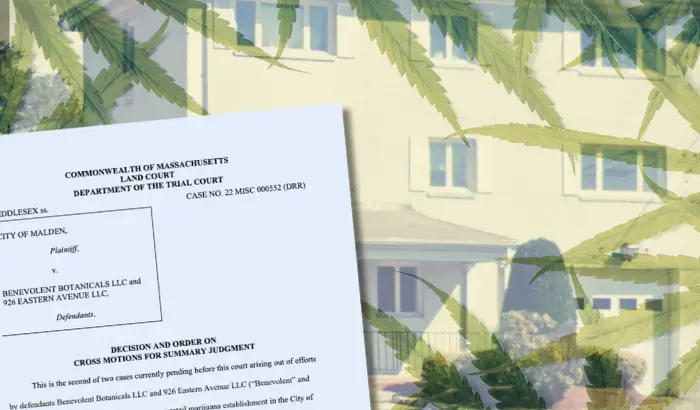
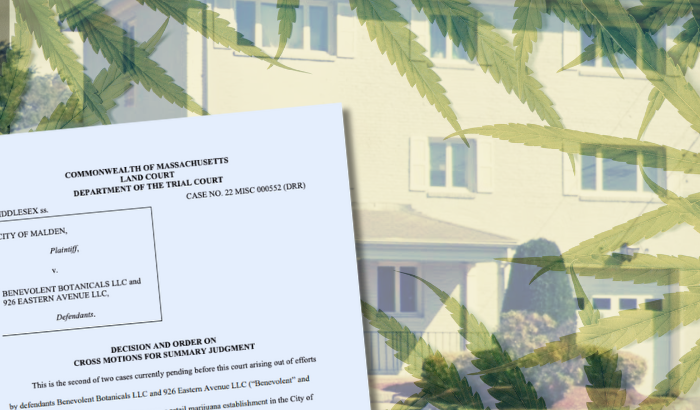
In a final judgment from the Massachusetts Land Court in the matter of Benevolent Botanicals LLC and 926 Eastern Avenue, LLC v. City of Malden, on Jan. 29 a judge wrote that, in violation of state law, the city’s framework was indeed “unreasonably impracticable” because it created a barrier to entry that no business could overcome.
The court defined “unreasonably impracticable” as measures that subject licensees to outrageous risk or require such a high investment of risk, money, or time that a “reasonably prudent businessperson” wouldn’t enter the industry in their right mind.
“All we wanted was to open our location and become a vibrant member of the Malden business community.” Michael Clebnik, the long-suffering CEO of Benevolent Botanicals, was candid as usual in discussing the decision with Talking Joints Memo. “With the ruling and the ordinance stricken in its entirety, Benevolent will now move forward with our plans to open.”
‘Impassable barrier’
Malden currently has two dispensaries open for business—Eastern Cannabis Company and Misty Mountain Shop—but other applicants have been unable to open. Those two stores also waited for obscene lengths of time and faced separate hurdles, but were able to cross the finish line.
As for those in queue, chiefly Benevolent Botanicals, the rub was over zoning; specifically, ridiculous parameters that Malden put in place. The building its owners applied to occupy at 926 Eastern Ave. is 61 feet from the edge of a buffer zone, but the city said they have to be 75 feet away.
Benevolent claimed that the city’s buffer zone laws go beyond state regulations, which dictate that cannabis businesses cannot be opened within 500 feet of a school. Malden’s law extends that to within 75 feet of residential and religious spaces, substance use treatment centers, and daycares, plus at least 250 feet from parks.
Over the course of years, the court examined whether these local restrictions violated the state’s marijuana statute. Did the City of Malden’s zoning bylaw effectively “zone out” retail marijuana establishments by making it impossible to find compliant sites?
At the figurative center and literal edge of the protracted dispute was a 75-foot residential buffer zone. The plaintiffs argued that the Northern Strand Community Trail, which is between their property and a residential area, should be considered an “impassable barrier” that rendered the distance requirement moot.
The court ultimately agreed that physical obstructions made the buffer zone logic inapplicable in this location, noting that the trail is impassable for all practical purposes and that there is a 10-foot-high chain fence with barbed wire along the rear boundary of the property.
“We are pleased that the judge ruled in our favor,” Clebnik said. “But the victory is bittersweet for certain.”
Sanctions
In the end, the court emphasized that Benevolent Botanicals is a state-recognized social equity participant and that Malden’s restrictive zoning hit such entities the hardest.
Per the ruling, the court effectively struck down the restrictive bylaw and opened a path for the plaintiffs to proceed with their business. The invalid bylaw no longer applies, and Benevolent may finally proceed to seek any other local permits needed to operate.
The judgment also opened the door for plaintiffs to apply for attorneys’ fees to cover certain costs related to their unbelievable half-a-decade long inconvenience. For their troubles thus far, specifically the city’s failure to comply with discovery obligations, the court ordered that Benevolent be awarded more than $18,000 in sanctions.
Throughout the trial, the City of Malden was criticized for failing to provide hundreds of pages of relevant documents until proceedings were already underway. In highlighting one especially embarrassing development, the court didn’t ultimately find a “willful scheme,” but rather characterized the city’s behavior as “bumbling disorganization.” Furthermore, the plaintiffs’ trial prep and strategy were prejudiced by Malden’s failure to conduct a diligent records search and to furnish documents relevant to key issues in dispute.
Moving forward
Before his wrestling match with Malden, Clebnik founded seven non-cannabis companies, spanning the smoke alarm industry to ecommerce and fantasy sports. With a laugh stuck in his throat, this week he told me this has been “the worst business experience” he has ever had.
Clebnick sounds inspired, though, and who wouldn’t be after defeating an op who was drunk on a bottomless shot glass of taxpayer whisky to embolden a comically flimsy defense? I’ve spoken with him throughout this whole nightmare, and he sounds more determined than ever to “open and become a big tax-producing player, bring jobs, and bring opportunity.”
Warren Lynch, the social equity applicant on the Benevolent team, dropped some poetry on Facebook: “Maybe I’ll never get a dollar out of this,” he wrote of the decision, nevertheless extolling the opportunity to “finally have a chance to sell legal cannabis in Malden.”
“Thank you so much to … Michael Clebnik and [building owner] Gary Oshry for hanging in there during this brutal [four-plus] year lawsuit!” Lynch continued. “We won!”